High-risk Materials requirements for suppliers
What truly drives Avon is our purpose: to create a better world for all.
What truly drives Avon is our purpose: to create a better world for all. We remain committed to this purpose by continuously improving our social and environmental impact. Our sustainability vision is to create a better world for women because a better world for women is a better world for everyone.
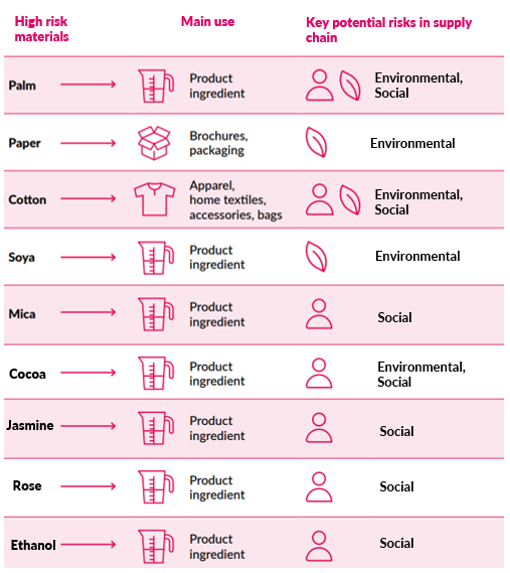
As part of our sustainability journey, we recognize that some of the materials we use carry significant social or environmental risks. Therefore, we require our suppliers to provide full traceability to the country of origin for feedstock cultivation or mining.
We are committed to achieving full certification for palm oil and paper used in our own operations by 2025, and for Avon-branded products manufactured by our contract manufacturers and external vendors by 2030. The detailed requirements are outlined in our Palm and Paper Policies, which also specify certain exclusions.
For other high-risk materials, we have developed dedicated guidelines, presented in the tables below. This targeted approach enables us to better manage and mitigate the environmental and social impacts associated with these materials.
We expect all suppliers to adhere to these guidelines, as well as to our Palm and Paper Policies.
For more information please refer to suppliers section on Avon website: Suppliers | Avon (avonworldwide.com).
In case of any questions regarding these requirements, please contact: critical.materials@avon.com
Important note: it is required to receive an exception approval from Avon in case our requirements are not met. Exception can be granted only if sufficient alternative due diligence is assured.
|
Critical / high-risk material* |
Traceability |
Certification** |
|
Paper (paper packaging, paper products)
|
n/a For more details please refer to paper policy. |
100% recycled paper (PCR preferred) or Paper must be FSC certified (a preference) or PEFC certified, if FSC not available. Certificate type and number must be provided. For more details please refer to paper policy. |
|
Palm |
Information on mills (as a minimum), refineries and provinces of cultivation to appointed third parties. For more details please refer to palm policy. |
Palm must be certified: minimum Roundtable on Sustainable Palm Mass Balance (RSPO MB). PO and/or PKO content, certificate type and number must be provided. For more details please refer to palm policy. |
|
Cotton |
Information required on country of cotton cultivation (where cotton is grown). This is applicable for both raw ingredients and fabrics. |
Applicable for fabrics with cotton only: 100% recycled cotton or If country of cotton cultivation is Benin, Burkina Faso, China, Kazakhstan, Tajikistan, Turkmenistan, Uzbekistan***, cotton must be certified: Regenerative Organic Content (ROC) or Global Organic Textile Standard (GOTS). For remining origins, in case of fabric, Cotton made in Africa Hard Identity Preserved certification is our preferred solution. |
|
Mica |
Information required on country of mica mining. In case of India, also state information required. |
Evidence of third party verification of processors and mines must be provided, in case of India origin for mica. Acceptable standards: RMI, IRMA, SMETA, SA8000, BSCI or equivalent. |
|
Ethanol**** |
Information required on feedstock and country its of its cultivation. |
In case of sugarcane feedstock origin from Bolivia, Brazil, Colombia, Ecuador, Egypt, India, Indonesia, Iran, Mexico, Myanmar (Burma), Pakistan, Peru, Philippines, South Africa, Thailand, Vietnam3, ethanol certification is required: Bonsucro; ProTerra Foundation; Organic Certified; Fair For Life; Fairtrade International or equivalent. |
|
Soy |
Information required on country of soy cultivation. |
If country of cultivation is Brazil, Argentina, Paraguay or Uruguay3, soy certification is required: Round Table on Responsible Soy Mass Balance; Round Table on Responsible Soy Segregated; ProTerra Foundation; Fairtrade International; Fair For Life; Organic Certified or equivalent. |
|
Cocoa |
Information required on country of cocoa cultivation. |
If country of cultivation is Brazil, Cameroon, Côte d’Ivoire, Ghana, Guinea, Nigeria or Sierra Leone***, cocoa certification is required: Fairtrade International; Rainforest Alliance; Organic Certified or equivalent. |
|
Jasmine |
Information required on country of jasmine cultivation. |
If country of cultivation is Egypt or India, supplier/fragrance house/processor membership of the Fair Labor Association (FLA) Harvesting the Future on Egyptian Jasmine is required or Fragrance House Human Rights Risk Assessment (HRRA) for India |
|
Rose |
Information required on country of rose cultivation. |
If country of cultivation is Turkey, Egypt or Bulgaria, supplier/fragrance house/processor membership of the Fair Labor Association (FLA) Harvesting the Future on Turkish Rose is required or Fragrance House Human Rights Risk Assessment (HRRA) for Bulgaria and Egypt |
Certification schemes – additional guidance
|
Critical / high-risk material***** |
Certification scheme | Certification abbreviation & website |
Certification description |
|
Paper |
Forest Stewardship Council (FSC) | FSC |
FSC certification ensures that products come from responsibly managed forests that provide environmental, social and economic benefits. Accepted FSC claims: FSC 100%, FSC Mix 100%, FSC Mix%, FSC Mix Credit, and FSC Recycled (any claim). |
|
Paper |
Programme for the Endorsement of Forest (PEFC) | PEFC |
As global alliance of national forest certification systems, PEFC endorse national forest certification systems developed through multi-stakeholder processes and tailored to local priorities and conditions. Accepted PEFC claims: 100% PEFC Origin, **% PEFC certified, PEFC Recycled |
|
Palm |
Roundtable on Sustainable Palm Oil | RSPO MB RSPO SG RSPO IP |
An international standard designed to assure palm oil production is sustainable: legal, economically viable, environmentally appropriate and socially beneficial. |
|
Cotton |
Global Organic Textile Standard | GOTS |
Worldwide textile processing standard for organic fibres, including ecological and social criteria, backed up by independent certification of the entire textile supply chain. |
|
Mica |
Responsible Mica Initiative | RMI |
The Responsible Mica Initiative is a Coalition for Action committed to operating according to five principles which reflect our mission, goal-oriented programs, and partnership-based approach to enabling a responsible and sustainable mica supply chain in India free of child labour. |
|
Mica |
Initiative for Responsible Mining Assurance | IRMA |
The IRMA Standard is a voluntary assurance system offering independent third-party assessment and verification of environmental and social performance measures at industrial mine sites around the world. |
|
Mica |
SEDEX Members Ethical Trade Audit | SMETA |
SMETA is SEDEX’s social auditing methodology, enabling businesses to assess their sites and suppliers to understand working conditions in their supply chain. |
|
Mica |
Social Accountability International | SA8000 |
The SA8000 Standard is the world’s leading social certification program. The SA8000 Standard and Certification System provide a framework for organizations of all types, in any industry, and in any country to conduct business in a way that is fair and decent for workers and to demonstrate their adherence to the highest social standards. |
|
Mica |
Business Social Compliance Initiative | BSCI |
A methodology for identifying and remediating risks in global supply chains. |
|
Sugar cane |
Bonsucro | Bonsucro |
Bonsucro is the leading global sustainability platform and standard for sugarcane only, one of the world’s most important crops. |
|
Jasmine |
Harvesting the Future - Jasmine in Egypt | Harvesting the Future - Jasmine in Egypt - Fair Labor Association |
Collaborative project to promote child protection and decent working conditions in the jasmine sector in Egypt |
|
Rose |
Harvesting the Future - Rose in Türkiye | Harvesting the Future - Rose in Türkiye - Fair Labor Association |
The project seeks to improve human rights and labor conditions in Türkiye’s rose sector, focusing on empowering seasonal agricultural workers and their families in the supply chains of project partner companies. |
|
Applicable across various materials |
ProTerra Foundation | ProTerra |
An international, non-profit, non-governmental organization with long-standing history and experience in promoting sustainability in the food and feed supply chain and segregated non-GMO materials. |
|
Applicable across various materials |
Regenerative Organic Certified | ROC |
An international standard that sets requirements for soil health, animal welfare, and farmworker fairness. |
|
Applicable across various materials |
Fair for Life | FFL |
An international, voluntary standard that sets requirements for third-party certification of fair trade and organic input and chain of custody |
|
Applicable across various materials |
Rainforest Alliance | RA |
An international standard assuring product or ingredient was produced using methods that support the three pillars of sustainability: social, economic, and environmental. |